
2025/12/31
The coming decade may well become a golden era for the resurgence of Japan’s economy and global influence.
Interesting Chart: China 10Y vs Japan 10Y Yield. Notice that now China is in Deflation and Japan is in Inflation. China going down and Japan going up. This maybe the most important historical figure.
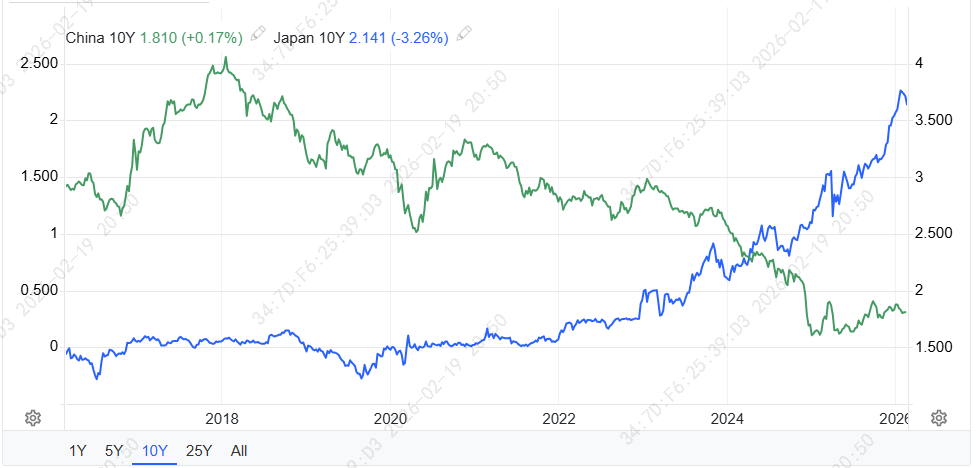
Looking back at 2025, the Nikkei Index continued to hit new highs, and the rally extended into the first quarter of 2026. It has now been six years since Warren Buffett invested in Japan’s five major trading houses, and we cannot help but admire the Oracle of Omaha’s foresight. He always seems able to distill patterns from human history and identify opportunities in the future. As our own research on Japan deepens, we would like to share our perspective on Japan’s future.
Since the bursting of the bubble 36 years ago, Japan has endured three decades of deflation. Meanwhile, the world has undergone dramatic changes. The Clinton administration’s decision to bring China into the WTO transformed China into the world’s manufacturing hub, fueling two decades of rapid economic growth—an economic miracle. Up until 2022, China continued to expand, while Japan seemed trapped in a deflationary quagmire. However, as relations between China and the U.S., China and Japan, and China and Europe have become increasingly strained, the United States has once again turned to Japan—its closest ally in the Asia-Pacific and arguably the world—to help maintain the post–World War II international order.
Among Western developed nations, Japan and South Korea are the only two countries capable of manufacturing everything from iron ore to automobiles, aircraft, and naval vessels. The U.K.’s last steel plant has already fallen under Chinese ownership and shut down its blast furnace years ago. Germany, once a manufacturing powerhouse, is now mired in left-leaning environmental politics, leaving its energy security uncertain. Japan, however, has preserved a robust manufacturing base. Beyond giants like Mitsubishi Heavy Industries and Kawasaki Heavy Industries, Japan still retains countless family-run workshops—an indicator of a highly resilient supply chain.
Meanwhile, the U.S. mainland currently has only two shipyards capable of supporting its vast navy, including both maintenance and new construction. The U.S. leads the world in AI and advanced fighter aircraft, but the war in Ukraine has reminded the world that the ability to rapidly produce basic weapons remains essential. Faced with China’s “printer-like” shipbuilding speed and its massive drone production capacity, the U.S. cannot realistically counter China’s influence relying solely on its own industrial base.
History moves in cycles. After the Plaza Accord, U.S.–Japan relations deteriorated, and the U.S. shifted its support toward China—leading to China’s rise and Japan’s decline. More than thirty years later, history is turning once again: the U.S. is embracing Japan anew to counter China’s growing power.
Japan’s greatest economic challenge has long been its aging and shrinking population. Yet today’s AI technologies may be the very solution to this problem. By deploying AI across industries, Japan can significantly enhance productivity. With its still-formidable manufacturing capabilities, Japan may be able to use AI to overcome the demographic constraints that have long limited its economic growth.
Looking ahead to the next decade, we believe Japan—this unique nation with its diligent people and relentless pursuit of excellence—can rise again through renewed close cooperation with the United States.
We have conducted in-depth research on investment opportunities in the Japanese market. If you are interested in investing in Japan or wish to further understand Japan’s future economic trajectory, please feel free to contact us.
日本語
今後の10年は、日本経済と国際的影響力が再び台頭する黄金期となる可能性があります。
2025年を振り返ると、日経平均株価は連続して過去最高値を更新し、その勢いは2026年第1四半期まで続きました。ウォーレン・バフェットが日本の五大商社に投資してからすでに6年が経ちますが、改めて「オマハの賢人」の先見性には驚かされます。彼は常に人類社会の歴史から法則を見出し、未来のチャンスを掴んできました。私たちも日本について研究を深める中で、日本の将来についての見解を共有したいと思います。
36年前のバブル崩壊以来、日本経済は30年にわたるデフレに苦しんできました。その間、世界は大きく変化しました。クリントン政権が中国をWTOに加盟させたことで、中国は世界の製造拠点となり、20年以上にわたる高速成長という「中国の奇跡」を実現しました。2022年以前、中国は成長を続ける一方、日本はデフレの泥沼に沈んでいるように見えました。しかし、米中・日中・中欧関係が硬直化する中、アメリカは再び日本というアジア太平洋、そして世界で最も緊密な同盟国に依存せざるを得なくなり、戦後の国際秩序を維持しようとしています。
西側先進国の中で、鉄鉱石から自動車、航空機、軍艦まで一貫して製造できる国は、日本と韓国の2カ国だけです。英国最後の製鉄所はすでに中国資本の管理下に入り、高炉も数年前に停止しました。製造大国ドイツは左派的な環境主義によりエネルギー安全保障が揺らぎ、産業基盤が弱体化しています。一方、日本は健全な製造業を維持しています。三菱重工や川崎重工といった大企業だけでなく、数多くの家族経営の町工場が残っており、これは日本のサプライチェーンが非常に強靭であることを意味します。
アメリカ本土には、膨大な海軍力を支える造船所がわずか2つしかありません。AIや先端戦闘機ではアメリカが世界をリードしていますが、ウクライナ戦争が示したのは、初級兵器を迅速に大量生産する能力が依然として極めて重要だということです。中国海軍の「プリンターのような」造船スピードや無人機の大量生産能力を前に、アメリカが単独で中国の影響力を抑えることは現実的ではありません。
歴史は繰り返します。プラザ合意後、米日関係は亀裂を生じ、アメリカは中国を支援し、中国は台頭し、日本は衰退しました。30年以上を経て、再び歴史は巡り、アメリカは中国の脅威に対抗するため日本を再び抱き寄せています。
日本経済を最も制約してきたのは、人口の高齢化と減少です。しかし現在のAI技術は、この問題を解決する鍵となり得ます。AIを各産業に導入することで、人間の生産性を大幅に引き上げることができます。強力な製造能力を依然として保持する日本は、AIの力を活用することで、長年成長を阻んできた人口問題という最大のボトルネックを克服できるかもしれません。
今後の10年を展望すると、勤勉で卓越性を追求する国民性を持つ日本は、アメリカとの再び緊密な協力関係を通じて、必ず再び大きく飛躍できると考えています。
日本市場の投資機会についても私たちは深く研究しています。もし日本への投資に関心がある方、あるいは日本経済の今後の動向についてさらに知りたい方は、ぜひご連絡ください。
 CYJ株式会社