
Saizeriya’s Q3 FY2026 Results:Strong Growth Numbers,Potential Menu Price Hike to Release Operating Leverage .
Background: In the 30 years deflationary environment in Japan, Saizeriya has kept menu price unchanged for 26 years. From September 2026, Saizeriya will increase menu price. As Saizeriya managment in the past few earnings quarters reiterated, they would keep price unchanged due to worry about consumer confidence. Finally in this week’s earnings call, Saizeriya management gave positive outlook of price increase. This is a token of the very end of the deflationary cycle of Japan. By year end 2026, BOJ will do another rate hike, following the 25bps rate increase in June. CYJ believe Japan is finally evolving into an inflationary cycle. And Consumer Companies like Saizeriya, may enjoy a huge operating leverage from price increases. Yen Devaluation – Export Increase – Wage Increase – Consumer staples price increase, it seems Japan is heading into a good economy cycle, for the moment.
Huge Operating Leverage ahead of Saizeriya Menu Price Change:26 Years Same
Excluding that technical adjustment ,the Milano-Style Doria has held in the same¥290–300 price range since it was cut to ¥290 back in 1999 —roughly 26 years at essentially the same price point.
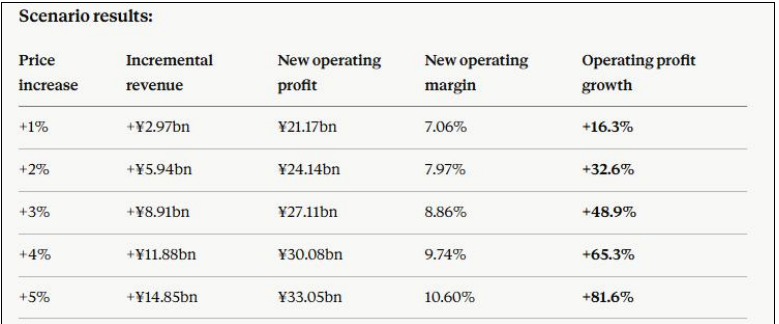
CYJ Estimates of Menu Price Increase and Operating Profit Growth.
3Q26 Results
On July 15 ,2026 ,Saizeriya Co.,Ltd.released its consolidated financial results for the first nine months of fiscal 2026 (September 2025 through May 2026).The cumulative figures continued the strong trajectory the company has shown over the past several quarters:
Nine-month revenue:¥221 .3 billion ,up 17.5%year-on-year
Nine-month operating profit:¥13.3 billion ,up 25.6%year-on-year
Full-year dividend forecast:raised by ¥5 to ¥35 per share (from ¥30 previously)
Alongside the earnings release,management also revised its full-year guidance for the fiscal year ending August 2026 :
Full-year revenue forecast:¥297.0 billion (+15.7%YoY)
Full-year operating profit forecast:¥18.2 billion (+17 .4%YoY)
Full-year ordinary profit forecast:¥18.3 billion (+15.8%YoY)
Full-year net profit attributable to parent:¥11.8 billion (+5.7%YoY)
By the end of May,Saizeriya operated 1 ,738 restaurants globally —1 ,063 in Japan and 675 overseas —reflecting continued net store additions across both segments.
What’s Actually Driving the Growth
The core story remains the same one that has defined Saizeriya’s recovery over the past two years:the domestic Japan business is doing the heavy lifting. Same-store sales in Japan have been rising on both higher customer traffic and higher average spend per customer,a combination that suggests the chain isn’t just benefiting from price increases —it’s also pulling in more diners.Menu strategy adjustments and continued investment in digital/DX tools (self-order kiosks,staffing efficiency,etc.)were cited as contributing factors.
On the international side ,Saizeriya continues to expand its footprint in Greater China and Southeast Asia.A new factory in Guangzhou was completed in January 2026 ,supporting a fresh store opening in Wuhan,while Vietnam added its third location.This overseas expansion remains a smaller share of the overall business but is a structural growth lever management continues to invest behind.
Why the Stock Jumped 17%Anyway
Here’s the more interesting part of the story:by most accounts,the Q3 results themselves weren’t actually a major surprise relative to expectations.Yet Saizeriya shares hit their daily limit-up the following day,July 16 ,closing at¥6 ,780 —up ¥1 ,000 ,or roughly 17.3%,from the prior close.
The real catalyst was a comment from President Hideharu Matsutani during the earnings briefing:he indicated the company is considering a price revision starting as early as September 2026 ,and —notably —floated a potential shift away from Saizeriya’s long-standing nationwide uniform pricing model toward location-based pricing (i.e.,charging different prices depending on the store’s location,presumably allowing higher prices in higher-cost or higher-demand areas like central Tokyo).
Analysts flagged that the tone here was meaningfully different from Saizeriya’s price-revision discussions back in 2025.One sell-side analyst (SMBC Nikko) noted that while the quarterly numbers themselves didn’t offer new information, the shift in nuance around pricing flexibility was read as a credible signal of improving pricing power and future margin upside —hence the market’s outsized reaction.
How to Read This
A few threads worth pulling on:
Margin expansion narrative reinforced —and arguably underappreciated by the current numbers.Saizeriya has built its recent turnaround largely on volume growth and cost discipline without needing to raise prices aggressively —a notable achievement in an industry where peers have leaned harder on price hikes.That restraint is precisely why a pricing move now matters so much:the company has been growing profit almost entirely through traffic and operating leverage ,with pricing power essentially untapped.A shift toward selective ,location-based pricing would let Saizeriya capture materially more revenue in higher-cost urban locations(central Tokyo and other prime real estate where rent and labor costs are highest)while preserving its low-price image in suburban and regional markets.Because Saizeriya’s cost structure is so heavily fixed (rent ,kitchen labor,central kitchen/logistics),even a modest price increase —say low single digits on a subset of high-traffic urban stores —tends to flow through to operating profit at a much higher rate than it does to revenue,since most of the incremental price simply drops to the bottom line rather than being absorbed by variable costs.Given operating margins are still in the midsingle digits,the earnings leverage from a genuine price increase could be substantial:this is arguably the single biggest lever available to management for closing the gap between revenue growth and profit growth ,and could
plausibly re-accelerate profit growth well above what traffic gains alone have delivered.
Full-year net profit growth (+5 .7%)is more modest than operating profit growth (+17 .4%).This gap is worth watching —it may reflect one-off items, tax effects,or continued reinvestment (new store openings,the Guangzhou factory,overseas expansion)weighing on the bottom line even as core operations strengthen.Investors focused purely on the bottom-line print might reasonably ask why profit attributable to parent isn’t tracking closer to operating profit growth.
Market reaction outpaced fundamentals.A 17%single-day move on a comment (not a formal guidance revision)about pricing strategy for a fiscal year that hasn’t started yet is a reminder that the stock is trading heavily on forward-looking margin expectations rather than trailing results alone.That creates both opportunity and risk:if the pricing shift doesn’t materialize as concretely as the market is currently pricing in ,some of this move could unwind.
Dividend increase is a smaller,more concrete positive.The ¥5 bump to¥35 per share is a modest but tangible signal of confidence from management ,and continues a trend of shareholder-friendly capital allocation alongside the growth investment.
【背景】 日本の30年にわたるデフレ環境下において、サイゼリヤは26年間、メニュー価格を実質的に据え置いてきました。しかし、2026年9月よりついにメニュー価格の改定に踏み切ります。これまでの数四半期にわたる決算説明会で、サイゼリヤ経営陣は消費マインドの冷え込みを懸念し、価格据え置きの姿勢を強調してきました。しかし今週の決算発表で、経営陣は一転して値上げに対して前向きな見通しを示しました。これは、日本におけるデフレサイクルの完全な終焉を象徴する出来事と言えます。6月の25bpsの利上げに続き、日本銀行は2026年末までにもう一段の利上げを行うと予想されます。当社(CYJ)は、日本がいよいよインフレサイクルへと本格的に移行しつつあると考えています。サイゼリヤのような消費関連企業にとって、価格改定は巨額のオペレーティング・レバレッジ(営業レバレッジ)を享受するきっかけとなるでしょう。円安、輸出増、賃上げ、そして生活必需品の値上げ。日本は今、一時的とはいえ、好循環な経済サイクルへと向かっているようです。
【サイゼリヤの価格改定:26年間の価格据え置きがもたらす巨大な営業レバレッジ】 技術的な調整を除けば、看板メニューの「ミラノ風ドリア」は、1999年に290円に値下げされて以来、約26年間にわたってほぼ同じ価格帯(290円〜300円)で販売され続けてきました。
2026年8月期 第3四半期決算分析
2026年8月期 第3四半期決算の概要
2026年7月15日、株式会社サイゼリヤは2026年8月期第3四半期(2025年9月〜2026年5月)の連結決算を発表しました。累計数値は、過去数四半期にわたる力強い成長軌道を維持しています。
- 第3四半期累計売上高:2,213億円(前年同期比 17.5%増)
- 第3四半期累計営業利益:133億円(前年同期比 25.6%増)
- 期末配当予想:1株あたり35円に増額(前回予想30円から5円増)
決算発表と同時に、2026年8月期の通期業績予想も上方修正されました。
- 通期売上高予想:2,970億円(前年同期比 15.7%増)
- 通期営業利益予想:182億円(前年同期比 17.4%増)
- 通期経常利益予想:183億円(前年同期比 15.8%増)
- 通期親会社株主に帰属する当期純利益予想:118億円(前年同期比 5.7%増)
5月末時点で、サイゼリヤは世界で1,738店舗(日本国内1,063店舗、海外675店舗)を展開しており、両セグメントで着実に店舗数を純増させています。
成長の原動力
ここ2年間のサイゼリヤの回復を定義づけてきた構図は変わりません。日本国内事業が成長を牽引しています。国内既存店売上高は、客数と客単価の両面で上昇しており、これは単なる値上げの恩恵だけでなく、より多くの顧客を取り込めていることを示唆しています。メニュー戦略の調整や、デジタル/DXツール(セルフオーダー端末、スタッフの業務効率化など)への継続的な投資が寄与していると指摘されています。
海外展開においては、中華圏や東南アジアで足元を固めています。2026年1月に広州の新工場が完成し、武漢での新規出店を支えているほか、ベトナムでも3店舗目が加わりました。海外事業の全体シェアはまだ小さいものの、経営陣が投資を続ける構造的な成長レバーとなっています。
なぜ株価は17%も急騰したのか
興味深いのはここからです。多くの見方によれば、第3四半期の決算内容自体は、市場の期待に対して大きな驚きを伴うものではありませんでした。しかし、翌7月16日のサイゼリヤ株はストップ高となり、前日比1,000円(約17.3%)高の6,780円で引けました。
最大のカタリストは、決算説明会での松谷秀治社長のコメントでした。社長は2026年9月以降の価格改定の可能性を示唆し、特に注目すべき点として、長年維持してきた全国一律価格モデルからの転換、すなわち「立地別価格設定(家賃や人件費の高い東京中心部などで価格を高く設定するなど)」の導入を検討していると明かしました。
アナリストたちは、この発言のトーンが2025年当時の価格改定議論とは明確に異なると指摘しました。あるセルサイド・アナリスト(SMBC日興証券)は、「四半期数値自体には新しい情報はなかったが、価格設定の柔軟性に対するニュアンスの変化は、プライシングパワーの向上と将来の利益率アップの確かなシグナルと受け取られた」と分析しており、これが市場の過剰とも言える反応を招いた要因です。
読み解くべきポイント
いくつか深掘りすべき論点があります。
- 利益率拡大のストーリーが強化された(現状の数字には十分に織り込まれていない可能性がある)。 サイゼリヤはここ最近の業績回復を、激しい値上げに頼ることなく、販売数量の増加と徹底したコスト管理で成し遂げてきました。これは競合他社が値上げを重視する業界において特筆すべき実績です。この「抑制」こそが、今回の価格戦略が重要である理由です。これまで利益成長は客数とオペレーティング・レバレッジによるものであり、プライシングパワーは実質的に未開拓でした。立地別の価格設定へ移行すれば、都心部等の高コスト拠点では収益を最大化しつつ、郊外では低価格イメージを維持できます。固定費(家賃、厨房人件費、セントラルキッチン/物流)が非常に高い構造であるため、都心の一部店舗で低単価の微調整を行うだけでも、変動コストに吸収されることなく、その大部分が営業利益のボトムラインに直結します。営業利益率がまだ1桁台半ばであることを踏まえると、真の値上げによる収益レバレッジは甚大であり、客数増だけでは成し得なかった利益成長を再加速させる可能性があります。
- 通期純利益成長(+5.7%)が営業利益成長(+17.4%)に比して控えめ。 この乖離には注視が必要です。一過性の損失や税効果、あるいはコア事業の強化と並行した先行投資(新店開発、広州工場、海外展開)が最終利益を圧迫している可能性があります。純利益の結果だけを見る投資家は、なぜ親会社株主に帰属する純利益が営業利益の成長と連動していないのか疑問に思うかもしれません。
- 市場の反応はファンダメンタルズを先行している。 まだ始まってもいない新年度の価格戦略に対する「コメント一つ」で株価が17%動いたことは、市場が現在の業績だけでなく、将来的な利益率改善の期待値で動いていることを示しています。これはチャンスであると同時にリスクでもあります。もし価格転換が市場の織り込みほど具体的に進まなければ、この上昇分の一部が剥落する可能性があります。
- 配当増額は、より小規模だが確実なプラス材料。 1株あたり5円の増額(計35円)は、経営陣からの控えめながらも確かな自信の表れであり、成長投資と並行して株主還元を重視する姿勢を継続していることを示しています。

